
Part 1 - The Readiness Gap: The Developmental Crisis No One Is Willing To Talk About (AKA The Gen Z Stare)
Echo Number 7: Social media is causing serious developmental delays.

We often talk about mental health in the digital age. Anxiety. Depression. Addiction. But what if the real crisis isn’t just emotional distress, it’s developmental delay?
A growing number of young people are arriving at adulthood unfinished. Not because they lack potential, intelligence, or support, but because the normal stages of psychological growth have been disrupted by the immersive, addictive nature of social media. We are now witnessing a generation-wide stall in emotional maturity, identity formation, impulse control, and self-concept integration. And no one is really talking about it.
This two part article explores the overlooked but deeply alarming link between chronic social media use and delays in core psychological and livelihood development, particularly during adolescence, a period critical for shaping emotional regulation, cognitive depth, interpersonal skills, and stable identity. What’s happening is not simply an increase in mental illness, but a rewiring of human development itself.
A Developmental Lens: What’s Being Delayed?
To understand the crisis, we need to start with developmental psychology. Adolescence is not just a time of hormonal chaos and bad decisions - it is a sensitive window during which we build lifelong capacities:
Emotional regulation (tolerating distress, managing mood)
Stable identity (understanding who we are independent of others)
Empathy and social perspective-taking
Social skills
Impulse control and executive functioning
Long-term goal setting and intrinsic motivation
In a healthy developmental context, these skills are built through trial and error, face-to-face relationships, solitude, reflection, and adversity. But social media offers a radically different environment, one dominated by instant feedback, artificial comparison, dopamine-driven validation loops, and the constant pressure to perform.
Instead of helping teens mature, social media conditions them to seek external validation, avoid discomfort, fear authenticity, and become chronically dysregulated. These aren’t just “bad habits.” They are stalled developmental processes.
The Signs Are Everywhere—We’re Just Not Calling It What It Is
Many young adults today struggle with:
Difficulty managing basic emotions
All-or-nothing thinking
Fear of criticism and rejection
An unstable sense of self
Inability to plan long-term or delay gratification
Chronic self-comparison and low distress tolerance
We call it burnout. Or anxiety. Or "just how Gen Z is."
But what if we called it what it really is: a developmental delay caused by prolonged exposure to an environment designed to hijack growth?
Clinicians are starting to see this in therapy rooms. Teachers are seeing it in classrooms. Employers are seeing it in interviews. Yet few are connecting the dots. We are treating the symptoms, not naming the source.
The Social Network? No.
Children today are growing up without the building blocks of social development that previous generations took for granted. Where friendships once formed organically. By previously sitting next to someone in class, riding bikes in the neighborhood, or knocking on a friend’s door, many young people now default to isolation, choosing screens over human contact.
Parents, anxious about safety or clinging to digital convenience, often keep children indoors, where tablets and smartphones serve as both entertainment and social surrogate. As a result, children miss critical milestones in learning how to initiate conversation, read body language, navigate awkwardness, and build trust through shared real-world experience.
The fallout is profound: by the time these young people enter high school, college or the workforce, many struggle with basic social fluency. Making friends becomes a source of anxiety instead of joy. Loneliness sets in early and deepens over time, reinforced by years of digital interaction that rarely translates into embodied connection. This lack of early relational practice manifests not just in adolescence, but in the vacant expressions and self-consciousness.
How The “Gen Z Stare” Relates
The now-iconic “Gen Z stare,” a blank, expressionless, often haunting gaze shared across TikTok, selfies, and even in classrooms or therapy offices is far more than a passing trend or ironic, entitled pose that millennials believe it is, or Gen Z thinks they are performing. It represents something deeper, more psychologically urgent: a generational symptom of developmental disruption and existential disillusionment.
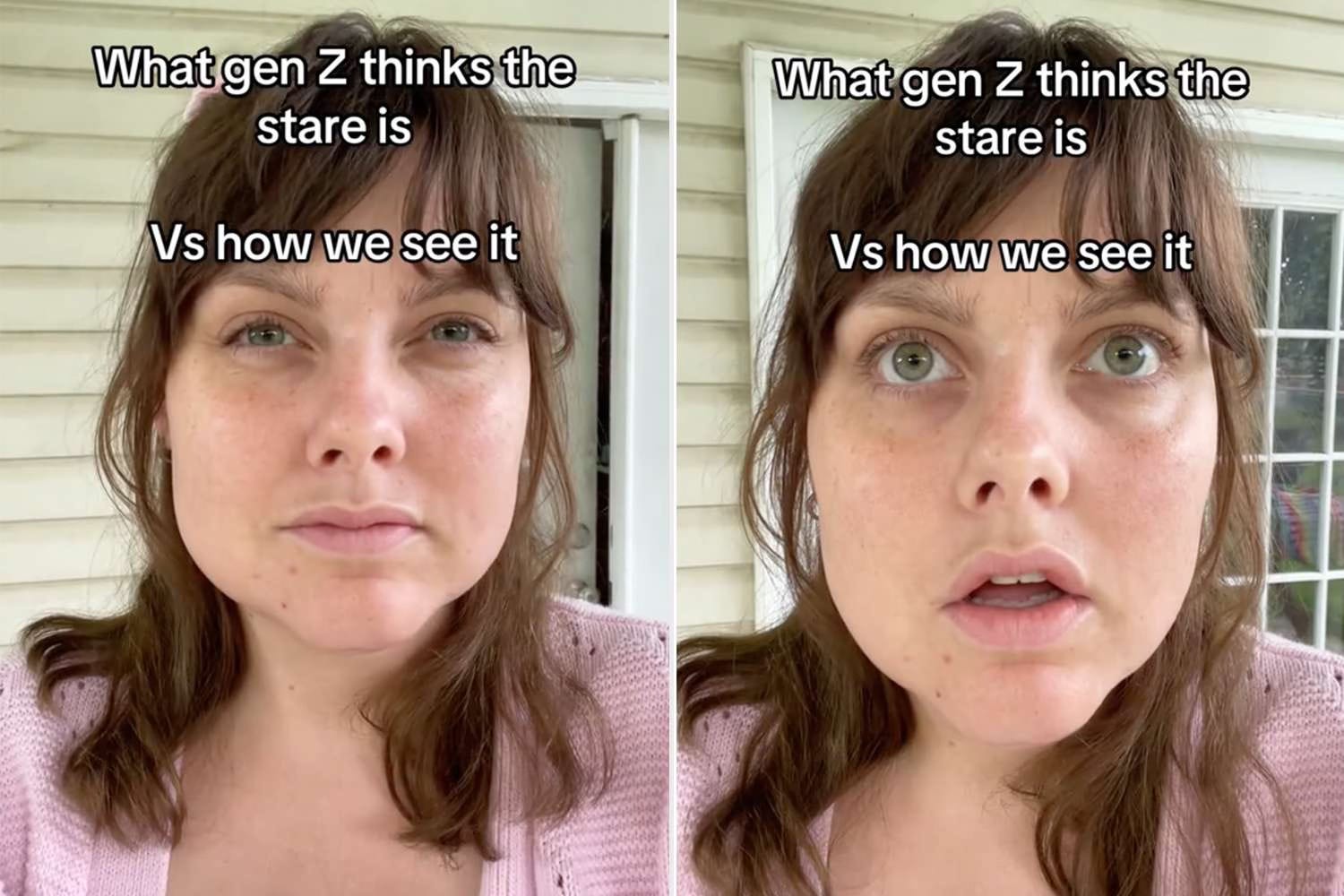
TikTok user @Tiltonicatiktok demonstrates Gen Z stare.
At its core, the Gen Z stare can be understood as a form of discontentment with the real world—a detached, hollow gaze that mimics the way young people stare at their phones, silently absorbing endless streams of perfected lives, filtered beauty, and performative success. It’s a reflective state, almost depressive, born from constant comparison to unreachable digital ideals. It visually communicates emotional overwhelm, identity confusion, and a growing detachment from both self and reality.
While the term itself is culturally emergent rather than clinical, mounting research supports the psychological patterns it reflects. First, we see signs of dissociation and emotional blunting: chronic overstimulation from platforms like TikTok and Instagram has led to widespread reports of numbness, disengagement, and emotional dysregulation.
This pattern and social disruption was only intensified by the COVID-19 pandemic, which trapped Gen Z inside during key developmental years. With school closures, social isolation, and heightened anxiety, the phone became not just entertainment, but a primary way to connect, cope, and even construct identity often at the cost of emotional presence and real-world engagement.
Second, there's a clear phenomenon of digital disillusionment, where real life feels dull, unsatisfying, or unworthy in comparison to the curated digital world. This creates a developmental mismatch, offline reality cannot meet the expectations that digital life has constructed.
Third, there is the impact of performative culture, where young people are constantly editing, curating, and broadcasting themselves, leading to a reduction in authentic emotional expression.
Lastly, the Gen Z stare reflects a growing sense of existential fatigue - a quiet refusal to emotionally invest in a world that feels broken, superficial, or overwhelming. Between climate anxiety, social injustice saturation, economic precarity, and the isolating effects of digital life, many young people are silently asking, what’s the point?
The stare becomes the outward expression of this internal state; a moment of shutdown, of non-participation, of passive witnessing. Beneath its surface lies stalled development, fractured identity, and the emotional residue of growing up in a world where perfection is always visible and never attainable.
The Gen Z stare is not a pose. It’s a symptom of a generation emotionally and developmentally overwhelmed by a life lived through screens. It becomes a mixture of poor emotional regulation (a key component in the Fourth Person theory), a disconnect of reality and expectations of such, and the social identity loss and fragmentation of personality through disenchanted social connections, friendships, and communications as humans always have communicated.
The Bigger Picture
The developmental delays we see today from emotional dysregulation to fractured identity are symptoms of a deeper shift I call the emergence of the Fourth Person: a digital self shaped by social media’s constant demands, pandemic isolation, and a world increasingly lived through screens.
This Fourth Person is disconnected from authentic experience, overwhelmed by performative pressure, and struggling to find grounding in reality. Yet the path forward is clear and timeless: we must return to baseline—the fundamental human practice of simply being before having or performing. Healing requires reclaiming presence, authentic connection, and the messy, unfiltered moments that have always nurtured growth.
Understanding how this process unfolds in the context of workforce readiness and emotional resilience will be the focus of the next part of this series, where we explore what it truly means for a generation raised online to step into adult life.
Yet again, you have nailed it, Kayleigh. As a high school teacher for decades I have personally witnessed the undoing of our kids. Teaching both psychology and languages to 16-17 year olds, i’ve seen the transformation of kid’s energy levels from excitement and engagement from the 90’s to the early 2000’s and then around the 2010’s, to a numbness a lack of energy, the Gen Z stare. How you describe the developmental delays that they have experienced is incredibly accurate. As educators, we need to strive incredibly hard each day to connect with our students and create a sense of safety and belonging in the classroom so that they can get a glimpse of what it feels like to be in authentic relationships and consider opening up, being vulnerable and sharing their thoughts around culture, food, relationships, language , love… The list is long.