
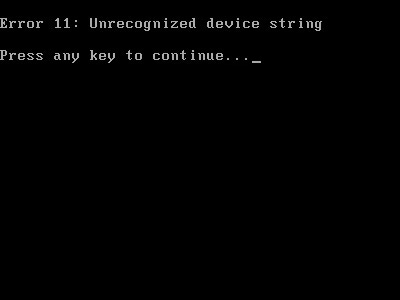
//:REBOOT: Press Any Key To Continue
Echo Number 17: CRTL+ALT+DEL+REBUILD

Over the last few weeks, I’ve been quiet on Digital Else. I’ve been submitting writing, finishing my first-ever live web series, and completing my medical school application (not a humble brag, it’s round two). I’ve been planning for my graduation, and prepping for my next degree. (And yes, I too unwind by watching Abbott Elementary). It’s been a fall of being human, and a fall I realized that I dreamed about as a young girl graduating elementary school… a dream I forgot about in my teenage years.
Now, fall is a time of year that demands structure of back to school, back to work, and back to weather that feels heavier. In many ways, it demands a reset. But this year, something felt different for me. It wasn’t sadness or burnout, and it wasn’t the typical “back to the grind” feeling I had last year. In remembering the goals I had when I was young, and now actually achieving them, this year I felt reminded of the shut down I experienced 4 years ago that I write about, and speak about.
From the time I was 13 until 21, my life was consumed by social media addiction and the psychosis it triggered. By the time I turned 21, I had attempted suicide six times and been hospitalized just as many. I was living almost entirely in perception, and a version of myself built for other people’s screens, not my own life.
At 21, my mental health again collapsed under the weight of a reality I couldn’t touch. I had fallen apart, and lost nearly everything (almost including the roof over my head, because I was spending money online, chasing trends, and trying to be somebody. Completely forgetting I already was someone).
That’s when I had what I can only call a hard shut down of the programmed being I had become. At 22, the shut down included deleting my social media. Like a desktop computer forced to shut down, you can hear the hum stop. The fan goes quiet. And when the screen flickers back to life, we read 5 words: press any key to continue.
“Continue with what?”
My milestones, my friendships, my sense of self, were all uploaded somewhere. And Gen Z is described as “the digital generation.” True, but, that doesn’t even begin to cover it. It’s not just that I was online and spent most of my time there. It’s not just that it made me sick, either. It’s about becoming digitally delayed, and that important point has been ignored in the rhetoric I read today.
The hard reboot wasn’t just a personal turning point, it actually revealed something much bigger to me about how we exist in the digital age. I call it The Fourth Person in my published research: a layer of self created entirely for the screen, shaped by likes, comments, and curated perceptions. It’s the personality we perform online, and begin to then perform offline, perceive life to be like offline, and reshape our offline life to match. This results in perceptions of perceptions not rooted in reality, maladaptive schemas of the world and distorted identity of the self. There is no more privacy. It causes high debt, catering to your fourth person’s perception of lifestyle. Interactions become shallow, staged, and lonely.
The Fourth Person watches, judges, and reacts. It grows in the gaps between who we are and who the world wants us to be. It distorts desire, inflates insecurity, and rewrites identity. And for anyone growing up in this environment, or worse, living with psychosis, addiction, or anxiety on the spectrum of problematic social media use, it does not just influence life, it fractures it.
And I’m tired of hearing those without the lived experience say deleting an app will solve the problems, or believing balance is the answer, and assuming “choice” was even part of the conversation in my home before the shut down.
It won’t, and it’s not, and it wasn’t.
It is not our fault. But we have been left to pick up the pieces.
We were kids, thirteen, fourteen, handed the tools to self-destruct and self-promote at the same time. Did anyone really expect us to grow into balanced adults? To become 25-year-olds who are thriving, confident, and whole?
If we’re seeing low employment rates, high debt calibers, extreme selves and algorithmic tendencies, AI psychosis and suicide — it’s just so much deeper than a generation that “wouldn’t get off their phones.”
It’s a completely false version of yourself (the basis of my theory, The Fourth Person).
It’s having no real connections, no real friends (especially as you approach the need for a hard reboot).
It’s having no real goals or aspirations, while each day passes in likes, comments, and endless doom-scroll spirals. It feels like addiction, pure and digital.
It’s not loving life. It’s not being ambitious. You don’t feel driven to do mundane things unless they’re validated by someone else.
It’s a literal psychosis of not knowing what’s real and what isn’t, a false sense of the world and the meaning of the word itself, watching others have friends, their Snap Scores increase, your life being scrolled by, and knowing it’s being wasted.
And I mean this wholeheartedly, please:
Raise your hand if part of your cleaning routine comes from what you saw on TikTok.
Raise your hand if your “desire to be up early” is real, or if it’s what that type of girl does.
Raise your hand if your workouts follow Instagram, not yourself.
Raise your hand if your toiletries, hair products and clothing are TikTok ads.
Raise your hand if you have three different stores tabbed on your phone with full carts.
Raise your hand if you want to go on vacation to say you went on vacation.
And finally, raise your hand if, when it’s all said and done… you’re alone.
Continue with what?
I asked myself this, too, when I deleted my social media. What’s next? And I’ll jump start your hard drive with some answers.
Continue with accepting reality, and beginning to know the world as it actually is, not as it had been filtered through screens, trends, and the Fourth Person. This isn’t easy, and it takes time. It feels unwavering, and it feels lonely. It can also feel like you’ve lost something, or are succumbing to lost dreams. I get that. I knew that feeling well. But over time, you’ll start to see that what felt real before was in fact a false projection, a false set of expectations, a false belief about who you were supposed to be.
We continue by retraining our minds to recognize what was real, what was imagined, and what had been rewritten into us. We continue by overriding the corrupted code, a full reboot after a hard crash. Not a refresh. Not a restore point. A complete restart. The screen goes black, the system rebuilds from nothing but the hardware that remains: our body, our brain, our will to live, and the memories of life before the programming. A reboot isn’t the return of the old self. It’s learning to be human again, with no downloaded updates to guide us. It’s clumsy. It’s glitchy. It’s relearning patience, joy, boredom, love, all without an algorithm directing where our attention goes. And one of the most important lessons I share with my patients, and on every stage I speak, is the power of rewriting our ending. We have that power, but only once we shut down who we’ve been wired to be. You can’t find yourself by temporarily disconnecting from the server, because who you were is still buried in the hard drive, humming quietly. You have to shut it down. You have to retrain it. And you have to restart.
For years, you’ve been trained to ask who you want to be, and your Fourth Person did its best to live that answer. To reverse this, start by asking why you wanted to change yourself in the first place. Asking why is a key indicator of hope, especially when we ask it not to fix an image, but to heal a system. That’s the first step after deletion.
There’s a process here. There’s no magic in the “x.” But there is power in the reboot, the complete system wipe that forces us to relearn what being human actually means. It’s the first quiet moment before you rebuild the mind.
Deletion isn’t the end.
It isn’t the answer. Nor a pause.
And it isn’t a detox.
It’s the reset that opens the door to these questions, and there is work that comes after. It’s the hard, messy, unglamorous beginning of reclaiming a life we never fully knew. It’s the slow reprogramming of time, connection, and identity, moment by moment, until the fragments of ourselves we thought were lost start to run again, unfiltered and real.
When I deleted my social media, I stopped asking what I wanted to be. I instead figured out why I so desperately wanted to be it. And this question opened doors to a life I thought was lost forever, and a girl I thought I’d never see again: the bright, bubbly and beautiful 13-year-old Kayleigh, who cared about the world, who found lights at the end of tunnels, and who felt love for her family, trust in her parents, kindness in herself. The parts of me hidden in the hard drive, humming quietly. The parts that drove the retraining, the values that existed in my heart.
This wasn’t easy to find. This wasn't easy to live. I had to find a safe place in my heart to be me again: to make mistakes, to not fear a finish line, and instead to know I could reach one. It took four years to pay off debt. I had to make amends, and to also accept what, and who, I had lost. I had to recover from the trauma of the hospital. I had to seek treatment for what had happened to me. And I had to begin to weed out the difference between choices I made, and choices made for me.
And now, this fall brought a new kind of reset, a reminder of beginnings and endings, of reflection and recalibration, of loss and regret. Summer fading into fall, a new chapter beginning, grieving (still) a life that was lost, embracing the one I actually chose and actually built, and yes, another medical school application. This fall, I realize I am living the life pre-social-media Kayleigh dreamed of, in my Toronto apartment, in love with my partner, caring for our pets, practicing peer support and, the newest addition to this dream and my rewritten ending, of researching social media use and abuse to help others who share my story. I’ve been social media-free for 4 years this January 2026, and I’ve spent these years working to get here, rebooting my mind.
I started writing 2025’s rhetoric in 2021. My diary became my rage, my despair, my loss which no one understood. And watching the world write about it years later in 2025 and get it wrong … I can understand why Gen Z feels lost.
But Gen Z isn’t lost. We’re digitally delayed.
Our emotions have been monetized, our debt gamified, our reality edited.
We are machines that learned to perceive. Code that learned shame. Profiles that learned to want.
When we hard reboot our digital delay, we’re building a new system from the bare hardware left. The fragments of who we were are still there in the hard drive, humming quietly, waiting for us to learn again how to run them. We have to let hope drive why we deleted, why we reset. And it’s those fragments waiting that become us again, not as we were previously programmed, but as something rewired by truth, rebuilt by time, and run by love. A hard drive is a hard drive. But it can always be overridden.
The Fourth Person will be overridden. Human will return. And you will remember the life you once dreamed of living… the one you imagined long before you began living a life you only dreamed of being perceived as having.
Your ending can be re-written. And the story doesn’t end with deletion.
It starts with a reboot.
Innovative Fourth Person vernacular. I can identify with your post. I also experienced a hard reboot of my mind, life and entire game plan during the time I spent incarcerated. Reinventing and reprogramming the self is real. Subscribed.